Where the Joy Is (New Release!)
Cellar Live
June 26, 2026
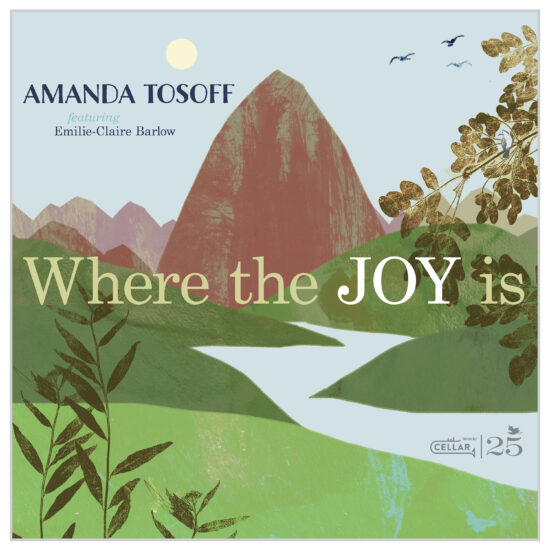
Liner Notes: “Where the Joy is” (2026)
This album is the third and final instalment of my Words Project — a body of work that brings together poetry, art-song, and jazz. It began in 2016 with Words, continued in 2021 with Earth Voices, and now concludes (for now, at least!) with Where the Joy Is. While the earlier albums drew on poetry across a range of themes, Where the Joy Is explores joy from different angles: in nature and childlike wonder, in the struggle of the artistic process, and in choosing love by letting go. It’s a record about returning — to the stage, to community, and to my love of music.
To explain what I mean by returning, I want to take us back in time to around 2020–21, when I released my previous album, Earth Voices. It was an ambitious project involving 17 musicians, 8 recording sessions, and countless hours of work — so it was a real letdown when the pandemic took away the opportunity to tour and promote it. I felt that releasing it at that time would be a waste of all that energy — but in the end, it was surprisingly successful in ways I couldn’t have imagined.
When touring started to return a few years later, Emilie-Claire Barlow — who sings on both Earth Voices and Where the Joy Is — encouraged me to book a tour with her and my band. I needed that encouragement. The pandemic had taken away my musical drive and left me with a crippling fear of performing, so this tour felt like an overwhelming undertaking, even though I’d done it many times before.
But I carried on, thanks to this incredible group of musicians. Before each performance, I’d silently psych myself up with a simple mantra: “I get to make music with my friends, I get to make music with my friends.” And that was exactly what happened every night: I made music with my friends, sharing it with new friends in each audience we played for. I was even able to reconnect with another old friend — music itself.
The title track “Where the Joy Is” was written during this time, as I was finding my way back to that joy. It features a wordless melody shared between vocalist Emilie-Claire Barlow and saxophonist Allison Au, with bassist Jon Maharaj and drummer Morgan Childs laying the foundation beneath them.
A few pieces on this album are ones I’ve recorded before, including “Little One,” which I co-wrote with bassist Jodi Proznick, a longtime friend I reconnected with during the pandemic. The piece sets a melody I composed to a lyric Jodi wrote for her son Tristan, capturing the playfulness and wonder of childhood, and reminding us that life really is a work of art — made up of simple moments we need to savour.
“Thoughts” is a song I wrote taking a poem by Marjorie Pickthall and shaping it into lyrics set to my own melody. I was drawn to her beautiful imagery of trying to cultivate the right conditions for her art, while struggling to tame the flow of her thoughts. Any artist can relate to the feeling of reaching for something just beyond one’s grasp, and the freedom that comes when you finally let go and let it come to you — or sometimes, just let it fly away.
The next tune, “The Fiddle and the Drum,” is one that I previously recorded on Earth Voices. It’s originally an out-of-time, a cappella melody by Joni Mitchell that I re-harmonized and re-imagined for my group. Written in the 1960s as an anti-war protest song, it felt timely to release my first recording of it back in 2021, and sharing this second version in 2026 now feels especially meaningful. I’m drawn to Joni Mitchell’s lyric “I can remember all the good things you are,” and I hold onto that sense of hope — a reminder of the humanity and goodness that can endure, even during uncertain times.
The jazz standard “This Time the Dream’s on Me,” written by Harold Arlen and Johnny Mercer, has always been one of my favourite ballads. I recently came across the original film version from Blues in the Night and was struck by a line one of the actors — playing a struggling musician in the story — says after the song ends: “I’ll never be alone if I just stay in the groove.” It felt like an appropriate reminder to me that music is something I can always turn to.
The album closes with “Love Said,” another song inspired by Marjorie Pickthall, this time building on her poem “Love.” I set her words to music and added a few stanzas of my own, continuing in the spirit of her poem. In the lyric, Love seems to ask the world to slow down — to soften the wind, to quiet time, to pause life’s relentless unfolding. But the answer that comes back is that these things cannot be controlled.
That idea feels central to this record. To try to control love — or time, or joy — is perhaps to lose sight of them. Love is present everywhere: in stillness and movement, in light and shadow, in abundance and uncertainty. I think joy is the same. It’s all around us. We just have to remember to look for it sometimes.
This album is about remembering that. About letting music unfold rather than forcing it. About trusting the people around me. About choosing, again and again, to move toward where the joy is.
I hope that you, the listener, will hear the joy in this music. I certainly do, and I’m so thankful to have captured it in the studio with my good friends Emilie-Claire, Allison, Jon, and Morgan (and, of course, my partner and audio engineer David Hermiston).